1905 Moscow Railway Strike
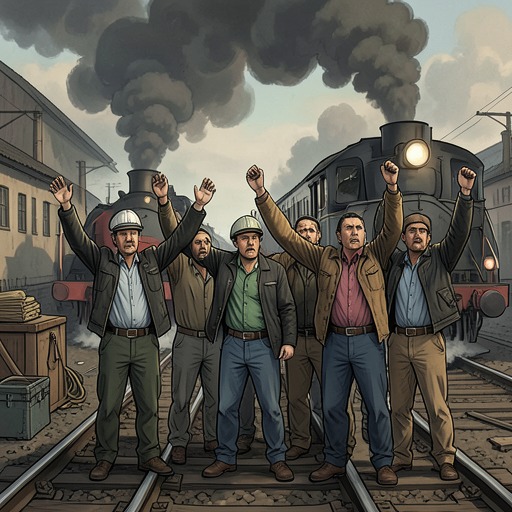
Doctor ZhivagoThe 1905 Moscow Railway Strike turns a brewing labor dispute into a collective stoppage, while exposing the gap between Tiverzin’s sense of personal agency and the committee’s actual role. Its onset is rendered through delayed decisions, a crowded railway workplace, and a signal whose meaning workers first mistake for an emergency.
Background and Setting
That autumn, railway workers across the Moscow network were restless. The men on the Moscow-Kazan line had already gone on strike, and workers on the Moscow-Brest Railway were expected to follow. The strike committee had decided that a strike would take place, but it was still arguing over the date. Railway workers knew a stoppage was coming; a pretext, rather than a settled schedule, was all that remained.
The scene begins on a cold, overcast morning in early October, when wages are due. The delay from the bookkeeping department gives the waiting workers time to gather and watch the routine of payment unfold. A boy eventually arrives with a pay sheet and records consulted for deductions of fines. Conductors, switchmen, mechanics and their assistants, and depot scrubwomen pass between the wooden management buildings and the station’s workshops, warehouses, engine sheds, and tracks. The ordinary wage transaction places labor and its administration at the center of the coming rupture.
The narration lingers over the railway’s working environment: trampled maple leaves, melted snow, engine soot, and warm rye bread from the station buffet’s basement; trains being shunted, coupled, and uncoupled; signal flags, locomotive hoots, horns, and whistles. Smoke climbs into the sky as steam hisses into the cold clouds. This sustained attention to routine makes the eventual stoppage legible as an interruption of a densely connected system, not simply a sudden political gesture.
Tiverzin and the Delayed Decision
After the confrontation at the lathe benches, Tiverzin breaks free of the men holding him and rushes out, slamming the door behind him. In the damp autumn night he strides away without turning around, muttering that people he tries to help come at him with a knife. He leaves angry at a world he sees as fraudulent and irrational, and walks as if speed could hasten the more harmonious future he imagines. The recent unrest, meetings, speeches, and decision to strike appear to him as stages on a larger road, though the strike has not yet begun.
The timing creates a crucial separation between his departure and the committee’s action. Tiverzin has left the underground shelter with Antipov before the committee, meeting there, settles on that night as the moment to strike. Its members allocate where each person will go and which workers will be called out. Thus the decision is made collectively and practically, through assignments, while Tiverzin is already away from the deliberation.
When the engine repair shop whistle sounds, it seems to Tiverzin to come from the depths of his own soul. The sound first comes hoarsely, then clears; meanwhile, workers are already moving out of the depot and freight yard. Men from the boiler room join them after downing tools at Tiverzin’s signal. His intervention matters, but it is not the sole cause of the strike: the committee has already chosen the hour and organized the call-out.
The Stoppage Spreads
The first workers who emerge ask where everyone is going and what the signal means. From the darkness, someone explains it as a fire alarm, and another voice accepts that explanation on the assumption that an alarm must mean there is a fire. The exchange shows how the workers’ movement can first appear in the familiar language of emergency response: people are called out, but the purpose is not immediately clear to everyone.
That misunderstanding gives way to recognition. Another worker dismisses the idea of a fire and identifies the action as a strike, rejecting the prospect of letting others be made to do the employers’ dirty work. The conversation shifts the crowd from uncertain response to conscious participation. More and more people join, and the railway workers are on strike.
The strike’s spread is both collective and locally signaled. Tiverzin’s signal brings the boiler-room men out, but the movement gathers workers from the depot and freight yard as well, against the background of the committee’s assignments. The narrative gives no single gesture the power to explain the whole stoppage: the whistle, the recognition of the signal, the decision not to continue working, and the committee’s organization all converge.
Memory, Agency, and Historical Consequence
Tiverzin does not know at the moment of the stoppage that the committee has already decided to begin that night. For years, he believes that he alone stopped work and traffic on the line. Only much later, at his trial, when he is charged with complicity in the strike but not with inciting it, does he learn what the committee had done after he left. The trial retrospectively corrects his memory: participation and influence were real, but the strike did not originate in his solitary initiative.
This delayed correction gives the event a double history. As it happens, the strike gathers force through a shared decision and the response of many workers; in Tiverzin’s recollection, it becomes for years a personal act. The eventual distinction between complicity and incitement makes the discrepancy concrete, while the late disclosure changes his understanding of his place in the movement. The stoppage is therefore presented not only as a labor action but as an event whose authorship is difficult to grasp from within its own momentum.